


On November 10, 2026, OpenAI launched Businesses in ChatGPT, and I believe businesses should be paying attention.
Having spent years leading sales and marketing teams, I’ve worked alongside some incredibly talented people trying to answer many of the same questions. How do we reach the right customers? How do we make better use of our data? How do we create content that influences decisions? And how do we connect that work back to revenue?
We’ve invested in SEO, paid media, marketing automation, analytics, and more tools than I could count. Some have fundamentally changed how we work. Others have given us even more information to sort through. The underlying challenge hasn’t changed: we need to understand how customers find us, what influences their decisions, and how we earn their business.
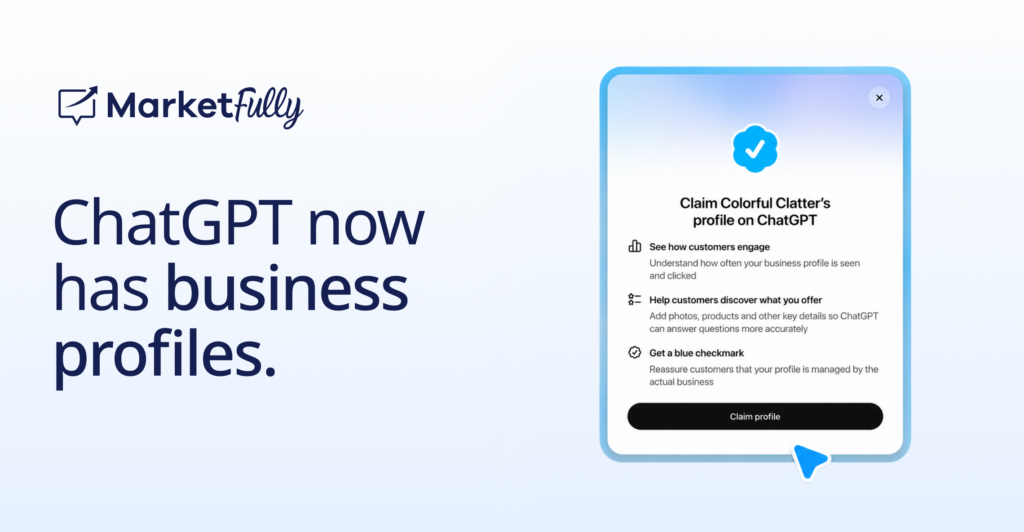
That’s why OpenAI’s November 10, 2026 launch of Businesses in ChatGPT caught my attention. This is not the ChatGPT Business subscription that companies buy for employees. It’s a new way for businesses to manage information about themselves inside ChatGPT, see aggregated discovery activity, and, if eligible, answer customers’ questions through a Business Agent.
We’ve spent years working to bring people to our websites. Increasingly, some of the research that determines whether they visit us at all is happening before that click.
What Is Businesses in ChatGPT?
OpenAI introduced Businesses in ChatGPT in beta with three main features.
1. A business profile companies can claim
Through Business Hub, eligible businesses can claim and verify their profiles, then update key details. Retailers can also provide product feeds with current pricing and availability. Think of it as another place where a company needs to make sure customers can find accurate information.
Imagine someone asking ChatGPT which companies help businesses localize websites or improve multilingual search visibility. The answer may influence which providers that person decides to investigate. A verified profile gives a company a way to manage certain information about itself. It does not guarantee a recommendation or higher placement in ChatGPT.
2. Analytics on how people discover businesses
This is the part I’m particularly interested in. Business Hub provides aggregated information about mentions, website clicks, and discovery topics. Those topics represent common themes in conversations where the company’s website is cited.
Say a business offers five services but is being discovered primarily for one. That’s worth knowing. It may raise questions about positioning, the information on its website, and whether prospective customers understand everything it offers.
There are limits. Businesses cannot see users’ individual ChatGPT conversations or Business Agent chats, and insights only appear when privacy thresholds are met. A mention is not a lead, and a click is not revenue. But this gives marketers another useful lens into discovery.
3. Business Agents for eligible companies
Eligible U.S. ecommerce and online service businesses can build, test, and publish a Business Agent. If a customer encounters a business in ChatGPT, they may be able to open its profile and start a clearly labeled conversation with that business’s agent.
The agent can answer questions about offerings using information the company provides. For a customer comparing options, this could make it easier to learn whether a product or service fits their needs. It also gives the business another opportunity to answer questions before a website visit or sales inquiry.
A Business Agent is separate from ChatGPT’s independent answers. OpenAI also allows sponsored Business Agent placements, which are clearly labeled. Not every business qualifies today, and it is far too early to assume these interactions will automatically translate into qualified leads.
What Businesses in ChatGPT Means for Your Marketing
One thing I’ve learned is that understanding how customers make decisions matters just as much as understanding where website visitors come from.
We measure traffic, engagement, conversions, form submissions, and pipeline. Those numbers matter, but they rarely tell us the whole story of what happened before someone raised a hand. Which options did they consider? Who was recommended? What information helped them narrow the list?
A potential customer can now ask AI to identify providers, compare capabilities, and explain the tradeoffs. By the time they get to a website, they may already have a shortlist.
That changes the questions I want our teams asking. Are we part of the relevant conversations? When we show up, are we described accurately? Are we easy to understand? And does what customers find reflect what makes us different?
I don’t believe traditional search is going away. I do believe we need to pay closer attention to the research that happens around it.
How We Help Prepare Your Brand for ChatGPT Discovery
At MarketFully, we help brands connect with customers across markets, languages, content, and digital channels. This announcement makes the connection among those disciplines even clearer to me.
Make the answer worth finding
Through Key Content, we help brands build content strategies around what customers are trying to understand. AI discovery only makes that work more relevant. A company needs content that clearly explains what it does, which problems it solves, and why the answer should matter to a potential buyer. More content is not necessarily better content.
Make it work across markets
Through MotionPoint, we help businesses deliver localized digital experiences. Customers in the United States, France, Germany, or Japan may describe the same need differently and evaluate providers through different expectations. Being visible in English does not mean a brand is equally well understood everywhere else. As AI discovery expands, that distinction deserves attention.
Remember the conversation
Through Social Element, we help brands build customer relationships through digital engagement and community management. AI agents add another setting in which customers can ask questions and form opinions. And those opinions are influenced by more than what the company says about itself. What people say to each other matters, too.
For me, these are not three unrelated issues. Content helps customers understand a brand. Localization makes that information relevant in different markets. Engagement helps turn interest into a relationship. The technology changes, but those needs remain closely connected.
Is Your Marketing Playbook Ready for AI Search?
I’ve been in marketing long enough to see plenty of technologies announced as the next big thing. Some changed the industry. Others created a lot of noise. I’m not interested in chasing every announcement, but I am interested in the ones that force us to rethink what customers are doing.
OpenAI’s launch is one example. Reddit Reviews is another.
Both have me thinking about how quickly customer research is changing, and whether businesses are willing to change with it.
If a marketing organization is still using the same playbook it used five years ago, measuring only the same things and assuming customers will keep making decisions the same way, I think it’s time to pay attention. That doesn’t mean abandoning the fundamentals. Good strategy, useful content, strong customer relationships, and a clear understanding of the audience will always matter. We do need to be willing to apply those fundamentals in new ways.
I don’t think we’ve seen the full picture yet. And you can bet MarketFully intends to be part of what comes next. Helping brands connect with customers across content, languages, markets, and digital experiences is already what we do. The opportunity is to keep pushing that work forward.
I’ll end with a line from one of my favorite movies, Step Brothers: “There’s so much more room for activities!”
That’s how I feel about marketing right now. There is more to explore, more to learn, and plenty of room for businesses willing to think differently.
Pay attention. I think we’re just getting started.
Stay Ahead of What’s Next
If you want to stay informed about what’s changing in AI, digital marketing, and customer engagement, sign up to receive our updates. We’ll share the developments we think businesses should know about and what they could mean for growth.
And if you’d like to learn how MarketFully can help your business reach new audiences, strengthen its digital presence, and connect with customers across markets, contact us to set up a conversation.
Sources
- OpenAI: Introducing Businesses in ChatGPT (November 10, 2026)
- Reddit: Introducing Reddit Reviews (November 10, 2026)