



Where multilingual content strategy is headed
Teams are moving faster than ever when creating multilingual content, yet speed and scale alone no longer determine success. Performance increasingly depends on how well content reflects local expectations and how easily it can be discovered.
Visibility, relevance, and trust are increasingly shaped by how well content fits the expectations of each market, not just whether it exists in the right language. As a result, global marketing teams are placing greater emphasis on planning, adaptation, and discoverability.
The following trends reflect how multilingual content marketing is evolving and what they mean for teams responsible for driving performance across languages and markets.
Trend #1: Translation alone no longer drives global growth
For many organizations, expanding into new markets historically meant translating existing content into additional languages. Today, this approach does not reliably lead to stronger results.
While audiences strongly prefer content in their own language, translation alone does not guarantee visibility, engagement, or trust. Many brands are translating at scale and still struggle to achieve meaningful performance across markets. Translated content can be accurate without feeling relevant or easy to discover by the intended audience.
A “translate everything” approach often increases output without improving performance. Global marketing teams are starting to treat translation as the foundation rather than the focus of their strategy. Growth depends less on how much content is translated and more on how well it reflects the expectations, behaviors, and competitive realities of each market.
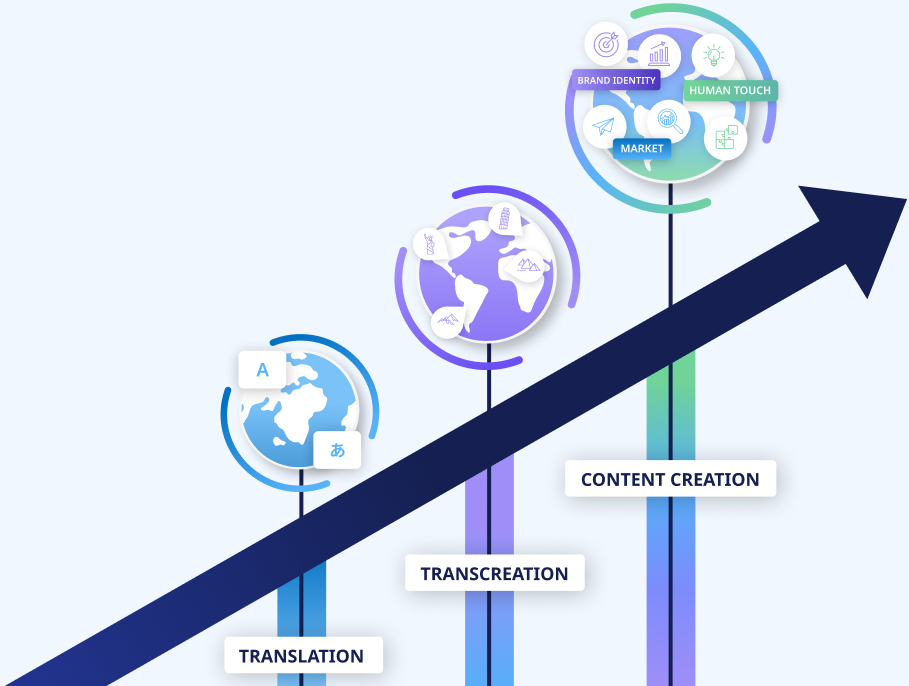
Trend #2: Brand and content adaptation becomes a marketing strategy
Marketing teams are becoming more deliberate about how and when content should be adapted based on each enterprise’s global strategic business objective.
Effective global marketing starts with clarity around brand voice, positioning, and purpose. With that foundation in place, teams can evaluate each asset based on audience needs, channel context, and market conditions.
Not every piece of content needs the same level of adaptation and treating it that way often leads to wasted effort or diluted messaging. Rather than applying the same approach everywhere, teams benefit from recognizing when content needs to be adapted and how it should be adjusted for each market.
Trend #3: Emerging technologies enable AI usage at scale with embedded brand governance and human review
Advances in AI have expanded what is possible in multilingual content production. Speed and scale have improved significantly, making it easier for teams to create and deliver content across multiple markets.
At the same time, human expertise remains essential. Interpreting intent, managing tone, and maintaining brand consistency still require human oversight, especially for content where accuracy and nuance matter most.
Rather than choosing between automation and human expertise, leading teams use both. AI supports scale, while human expertise provides clarity and confidence. Together, this approach makes multilingual content easier to manage and more reliable across markets.
Trend #4: Discoverability becomes central to global content marketing performance
Search behavior continues to evolve, with AI influencing how content is evaluated and surfaced. Content that reflects how users search and what they expect to find in their market is more likely to gain traction.
Discoverability is now a defining factor in multilingual content performance. Search increasingly prioritizes clarity, structure, and relevance over language presence alone. Simply translating an asset does not ensure it will appear where local audiences search.
This shift is pushing multilingual marketing beyond basic localization. To perform well, content must align with local terminology, formats, and search expectations. Even well-translated content can underperform if it is not built around how audiences discover and compare information locally.
As a result, discoverability is at the forefront. Teams are designing content with local intent in mind earlier in the process, increasing the likelihood that content surfaces in search results, recommendations, and AI-generated responses.

Bold Prediction: The function of localization will begin to report to CMO and fall under marketing departments.
Localization efforts are likely to fall under marketing departments as multilingual content plays a larger role in how brands are discovered, understood, and evaluated across markets. This is reflected in search visibility and in how clearly content resonates with local audiences.
As multilingual efforts are evaluated alongside other marketing initiatives, teams will place greater emphasis on understanding outcomes across regions and how those outcomes relate to the cost of localization. This allows marketing teams to assess where localization contributes most to visibility and engagement.
If this shift continues, localization will become part of broader marketing strategy. Marketing teams would decide which markets to prioritize and how much localization is needed in each one, with those decisions tied more closely to overall marketing performance.
Where these trends are leading global content teams
Many organizations are rethinking how global content is planned and managed. InContent Marketing reflects this shift by focusing on how multilingual content is created, adapted, distributed, and measured across markets.
Content is planned with a clear understanding of where it will appear, how it will be discovered, and what audiences expect locally. Decisions around adaptation are made deliberately, keeping content aligned with how it will be used and evaluated.
For global teams, InContent Marketing provides a practical way to manage complexity without sacrificing consistency. It helps teams determine when content should remain closely aligned to its original version, when it needs to be adapted, and when new content is required for a specific market, helping ensure content performs across languages, cultures, and markets.
The new standard for multilingual marketing
Multilingual marketing is no longer about how quickly content can be produced or how many languages it can be published in. The teams seeing consistent results are the ones making clear decisions about intent, adaptation, and discoverability from the start.
Translation remains essential, but performance is shaped by how well content fits the markets it enters and how easily it can be found and trusted once it is live. As global expectations continue to rise, multilingual content marketing increasingly depends on strategic planning, thoughtful adaptation, and ongoing performance insight.